
Inside Art Basel Paris 2026: 10 gallery presentations worth a collector’s attention
From a $2.25 million stone sphere to Nigerian modernism, rare graffiti paintings and works that challenge the boundaries between art and design, these are the gallery presentations that make Art Basel Paris 2026 worth looking at beyond the headline sales.
At Art Basel Paris, the price of a work is only one part of the story. A painting may command millions because of an artist’s established market, while a less expensive piece can offer a different kind of significance: a neglected chapter of art history, an emerging collector base or an approach to materials that has yet to become widely recognised. For collectors, the challenge is to distinguish the work that attracts attention today from the presentation that rewards closer examination.
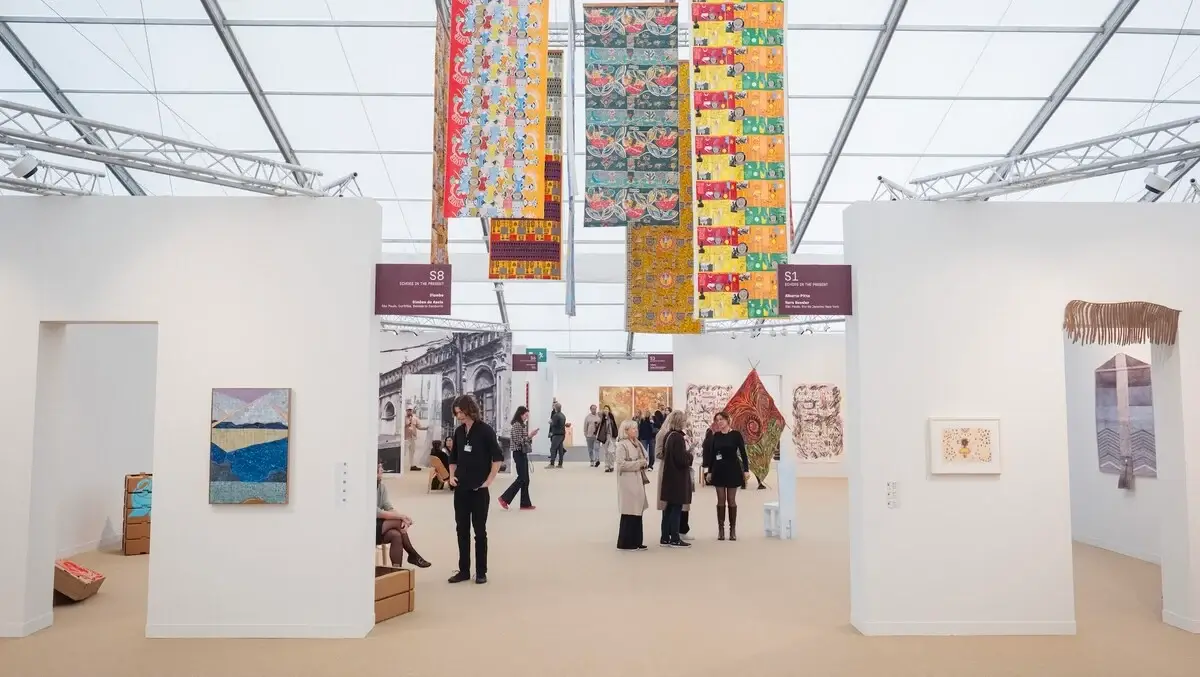
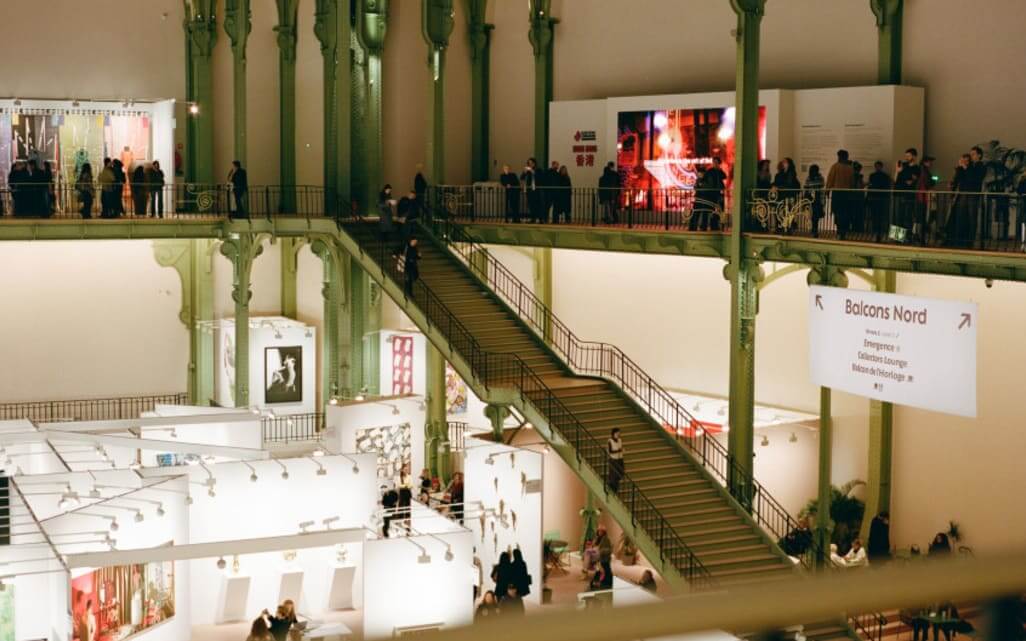
The fair’s fifth Paris edition brings together 211 galleries from 41 countries and territories at the Grand Palais. Its programme spans established names, younger galleries and historically overlooked practices, with a larger Premise sector devoted to presentations that revisit underrepresented artistic histories. These ten booths stand out for the stories they tell, the works they bring together and the questions they raise about collecting contemporary art.
1. Mennour: When a Stone Sculpture Becomes a Seven-Figure Conversation
Some booths compete for attention through the number of works on their walls. Mennour takes a more architectural approach. At its presentation, Ugo Rondinone’s the angelic (2024), a monumental figure constructed from roughly hewn, stacked stone blocks, rises above the surrounding works like an ancient monument transported into the contemporary art market.
The contrast is deliberate. Behind the sculpture hangs Manoucher Yektai’s Untitled (1962), an energetic abstract painting whose broad strokes of blue, green and white introduce a different kind of physicality. Further into the booth, Alicja Kwade’s Siège du Monde (2026) places an enormous pale blue-and-white stone sphere on a wooden chair, creating an unsettling tension between apparent fragility and immense weight.
The presentation also includes Anish Kapoor’s Random Triangle Mirror (2026), a reflective stainless-steel work that fractures the viewer’s reflection into shifting perspectives. It is an unusually effective meeting of sculpture, perception and spectacle, with a contemporary work that invites interaction sitting alongside references to the history of modern art.
According to Artsy, prices at Mennour’s booth start at approximately €250,000 and exceed €2 million. That range makes the presentation relevant to collectors at different levels of the high-end market, while the juxtaposition of historical and contemporary artists offers a broader view of how a gallery builds a coherent programme across generations.
2. Michael Rosenfeld Gallery and Jeffrey Deitch: Beauford Delaney Returns to Paris
One of the most compelling presentations at the fair centres on an American artist whose relationship with Paris was more than a footnote in his biography. Beauford Delaney moved from New York to the French capital in 1953, joining a community of artists and writers that offered new possibilities for his work and life.
More than seven decades later, Michael Rosenfeld Gallery and Jeffrey Deitch have brought a selection of his paintings back to Paris. The presentation traces his development from expressive urban scenes to luminous abstraction, including Untitled (Greene Street) (1950), a richly textured depiction of New York that captures his earlier visual language.
Delaney’s story adds a historical dimension to the booth. His career unfolded against the constraints faced by Black artists in the United States, while his paintings evolved towards increasingly abstract explorations of colour and light. His work has often occupied a less prominent position in mainstream narratives of modern American art than its quality and influence warrant.
The presentation places Delaney alongside contemporary artist Alteronce Gumby, creating a dialogue between generations around colour, abstraction and the possibilities of painting. The result is more than a retrospective display: it offers collectors a way to consider how artistic reputations are formed, reconsidered and expanded over time.
3. kó: The Nigerian Artists Rewriting the History of Modernism
The Lagos-based gallery kó brings three generations of Nigerian modernism into a single presentation, offering a perspective on art history that extends beyond the conventional European and American canon.
At the centre is the Nsukka School, an influential artistic movement that developed at the University of Nigeria following the country’s independence in 1960. One of its defining ideas was Natural Synthesis, associated with Uche Okeke, which sought to bring European modernist techniques into dialogue with indigenous Nigerian visual traditions. A particularly important influence was uli, an Igbo art form traditionally practised by women through body and wall painting. Its flowing lines, organic forms and rhythmic patterns offered a visual language that Okeke and his contemporaries could adapt to modern painting without abandoning their cultural references.
Okeke’s Return of the Refugees (1967) addresses displacement during the Nigerian Civil War. His student Obiora Udechukwu also drew on the visual vocabulary of uli, using sinuous lines to depict figures, landscapes and the consequences of collective hardship.
El Anatsui introduces another dimension to the presentation. Best known internationally for monumental works assembled from discarded metal bottle caps, he is represented here by a carved wooden sculpture made with a chainsaw. Its deep incisions explore destruction, transformation and the expressive possibilities of the material itself.
Prices reported for works at the booth range from approximately €60,000 to €205,000.
4. Sprüth Magers: The Art of Branding, Desire and Cultural Power
Sprüth Magers opens its presentation with a work that functions almost like a provocation. Barbara Kruger’s large-scale vinyl installation Untitled (Forget to remember) (2024) confronts visitors with a phrase that plays on the instability of memory and meaning.
Inside the booth, the theme of language continues through Sylvie Fleury’s pleasures (1990), a painting that repeats the word across alternating black and pink stripes. Her sculpture Patrick & Piet & Josef (I) (1996) places white slingback heels, accented with red, blue and black, on a pedestal whose coloured planes recall Piet Mondrian and Josef Albers.
Fleury’s work is particularly interesting in a luxury context. Fashion, branding and consumer desire are not incidental subjects here; they become material for examining how taste is constructed and how objects acquire cultural meaning. The high-end market itself depends partly on these mechanisms, from the symbolism of a fashion house to the status attached to a particular artist or design object.
The booth also includes an early Jenny Holzer work, IF YOU ARE CONSIDERED USELESS… (1983), a spray-painted canvas connected to the artist’s use of text in public spaces and her engagement with New York’s graffiti scene. Its presence offers a reminder that an established conceptual artist’s practice can emerge from work that was once deliberately outside conventional gallery culture.
Reported prices at the booth range from approximately €16,000 to €2.85 million, illustrating the breadth of its presentation.
5. Danysz Gallery: Futura and the Works That Rarely Leave the Books
Before graffiti became a recognised category within the international art market, Futura was helping to redefine what it could look like. The New York artist developed an abstract visual language that moved away from the lettering traditionally associated with graffiti, using floating forms, sharp lines and atmospheric bursts of spray paint.
Danysz Gallery presents works spanning four decades, with particular attention to paintings from the early 1980s that have rarely been exhibited. One example, Pony (1982), combines swirling reds, pinks and oranges with electric-blue marks and looping white lines. The historical context matters. In 1981, Futura established a relationship with British punk band The Clash, subsequently joining their European tour and painting live onstage during performances. The episode places his work at the intersection of street culture, music and the emerging international recognition of graffiti as an artistic language.
Paris also has a longstanding connection to the artist, making the presentation particularly fitting for the city. According to Artsy, major paintings from the 1980s at the booth are priced at around €200,000.
For collectors, the appeal lies partly in the opportunity to encounter works that have been less visible in recent exhibitions. But the fact that a painting is rarely seen does not automatically make it a better acquisition. Buyers still need to examine its provenance, condition, exhibition history and relationship to the artist’s wider body of work.
6. ATHR: Saudi Arabia’s Contemporary Art Scene Beyond the Headlines
Saudi Arabian gallery ATHR brings together established and younger artists from the Gulf, showing how contemporary practices in the region draw on everyday life, popular culture, historical memory and changing social environments.
Ayman Yusri Daydban works with found imagery, Arabic text and familiar objects. In one mixed-media assemblage, decorated tissue boxes are stacked alongside vintage portraits and printed lettering. The arrangement transforms commonplace domestic objects into a layered commentary on representation and cultural identity. Sarah Abu Abdallah approaches similar questions through intimate collages. Her works combine photographs, fragments of text and visual references drawn from everyday Saudi life. A composition featuring sliced watermelon and a feather emerging from a heart-shaped object demonstrates how ordinary images can become unexpected vehicles for humour, intimacy and cultural observation.
The presentation also reaches back to 1991 through works by Abdulrahman Al Soliman made in response to the Gulf War, alongside works by a younger generation represented by Mohammed Al Faraj. This historical range allows the booth to connect personal expression with broader regional experience. Reported prices range from approximately $4,000 to $30,000, making the presentation one of the more accessible entry points among the ten selections.
7. Mai 36 Galerie: When Photography Becomes Sculpture
At Mai 36 Galerie, the boundary between artistic media becomes the central attraction. Five photographic assemblages by Jacopo Benassi line the exterior of the booth. Each combines a black-and-white close-up of a thorny branch with painted botanical imagery, mounted inside a shallow wooden box and held together with metal straps.
The constructions look deliberately precarious. Photography, painting and sculpture become inseparable, and the tension between the materials gives the works their distinctive character. The pieces are priced at approximately €10,000 each, according to Artsy. Inside, Irma Blank’s Radical Writings series transforms repeated marks into abstraction. Her work questions the relationship between language and visual form, making writing appear less like a vehicle for information and more like an image in its own right.
Magali Reus approaches familiar objects from another direction. In Clementine (Full House) (2024), the recognisable form of a glass jar becomes a sculpture made from plaster, aluminium and steel. Elsewhere, photographs by Luigi Ghirri introduce quieter observations of architecture and domestic space. The booth also includes works by artists such as Peter Hujar, John Baldessari and H. R. Giger, bringing together different approaches to photography, conceptual art and image-making.
8. Xavier Hufkens: A Sculpture Designed to Make Visitors Stop
At Xavier Hufkens’s booth, the centrepiece is a work that invites visitors to interact with it in a surprisingly ordinary way. Tatiana Trouvé’s Sitting Sculpture (2024) measures more than three metres long and resembles pale, crumpled sheets draped over rough stone supports. Its painted aluminium surface creates ragged edges, folds and darkened crevices that make a rigid material appear soft and almost textile-like.
During the fair’s VIP opening, visitors were reportedly seen using the sculpture as a place to sit and rest. The detail captures something important about Trouvé’s work: it challenges the distinction between sculpture as an object to be viewed and sculpture as something that occupies the same physical space as its audience.
The presentation is notably spacious, allowing the work to be experienced from different angles without competing with a dense arrangement of surrounding pieces. In a fair where collectors move rapidly between galleries, the decision to give a single work room to breathe can be as effective as an elaborate installation.
9. Selma Feriani Gallery: A Wider View of Contemporary Art
Selma Feriani Gallery’s presentation brings together twelve artists working across painting, sculpture and photography. Themes of cultural memory, identity and the natural world provide a broad framework for a booth that spans different generations and artistic approaches. Its strength lies in the opportunity to encounter multiple practices within one presentation. Rather than concentrating on a single established name, the gallery creates a setting in which works can be considered in relation to one another, revealing connections between material, place and personal experience.
For collectors, this kind of group presentation can be a useful starting point for research. It allows visitors to identify artists whose work resonates with them and then investigate the wider context of each practice, including solo exhibitions, institutional recognition, gallery representation and previous sales. The approach also resists the temptation to treat an entire region or generation as a single artistic category. Individual artists have distinct histories and trajectories, and those differences matter when assessing a work’s significance.
10. MASSIMODECARLO: A Gallery Worth Watching for Its Curatorial Choices
MASSIMODECARLO is among the galleries highlighted in Artsy’s selection of notable Art Basel Paris presentations. Its inclusion is a reminder that a collector’s shortlist should not be based solely on headline prices or the visibility of a single artwork.
A gallery presentation is also an expression of curatorial judgement: which artists are placed together, how their works are framed and what kind of conversation the arrangement encourages. For a serious collector, those choices can be a useful prompt for further investigation, particularly when a gallery’s programme brings together established practices and artists whose work merits closer attention. Before making an acquisition, it is worth looking beyond the fair itself. An artist’s exhibition history, the consistency of gallery representation, institutional collections and the availability of comparable works can all help establish a more complete picture.
What Collectors Should Take Away From Art Basel Paris 2026
The ten presentations reveal several different ways to approach collecting. Mennour offers a dialogue between modern masters and contemporary sculpture; the joint presentation by Michael Rosenfeld Gallery and Jeffrey Deitch revisits an important chapter of American art history; kó brings Nigerian modernism into a wider international conversation; and ATHR provides a closer look at contemporary practices from the Gulf.
Other booths demonstrate the possibilities of collecting across media. Futura’s rare early paintings connect graffiti to the history of contemporary art, while Jacopo Benassi’s assemblages challenge conventional distinctions between photography and sculpture. Tatiana Trouvé’s monumental work, meanwhile, shows how a sculpture can reshape the way visitors move through a space.
There is no single formula for identifying a work worth collecting. Established market demand, historical significance, material innovation and personal conviction can all play a role, but they are not interchangeable measures. A strong auction record does not guarantee future appreciation, and an overlooked artist is not automatically an undervalued one.