
The precision behind the fold: Taro Yaguchi on origami as a discipline
Origami is often valued for the patience and precision it requires. For Taro Yaguchi, the greater challenge is changing what people see in a folded sheet of paper — and building a professional practice in which Japanese cultural heritage, original design and commercial value can develop together.
The moment an ordinary object became something more
Taro Yaguchi did not have a dramatic introduction to origami. Growing up in Japan, he encountered it as part of everyday life. His grandfather worked in a business related to traditional Japanese paper, while his mother was a woodcarver. Working with materials was familiar from an early age, although origami would not become a serious professional pursuit until much later.
The moment that changed his perspective came in the United States, around 2001. At an inventors’ convention, Yaguchi made paper aeroplanes from sheets printed with information about his patent firm. They were intended as promotional materials, but people responded to them more enthusiastically than they did to ordinary brochures. They picked them up, stopped to look and began conversations.
“That made me realize that something very ordinary to a Japanese person could be seen very differently outside Japan,” he says.
The encounter revealed a possibility that would shape his subsequent work: origami could reach audiences who had no particular connection to its cultural origins. Something familiar could become surprising when placed in a different context. The question was how to develop that interest beyond the initial appeal of a folded object.
For Yaguchi, the answer has involved expanding the ways origami can be experienced. Rather than limiting the practice to traditional models, workshops or small decorative pieces, he has explored its potential in design, corporate projects and large-scale installations. The ambition is not to leave its Japanese roots behind, but to find new ways for the tradition to remain relevant.
The difference between folding and designing
There is a point at which following instructions stops being enough. In origami, that transition begins when the artist starts thinking about the structure behind each fold: why it is necessary, how it affects the paper and what might happen if it is changed.
“You begin to think about where the paper is going, why a certain fold is necessary, and what would happen if you changed the structure,” Yaguchi explains. “That is when you slowly move from reproducing someone else’s design to being able to modify things and eventually create your own models.”
His background in engineering and patent law gives this process another dimension. Both fields involve understanding how individual parts relate to one another and how a structure can be made to perform a particular function. Origami offers a different material through which to apply that thinking, but the underlying questions are familiar.
Mathematics and geometry are always present. Angles, proportions, layers and the distribution of material determine what a model can become. Yet Yaguchi does not approach every design as a problem to be solved mathematically before the first fold. Intuition remains essential, particularly when a technically correct model fails to communicate the character of its subject.
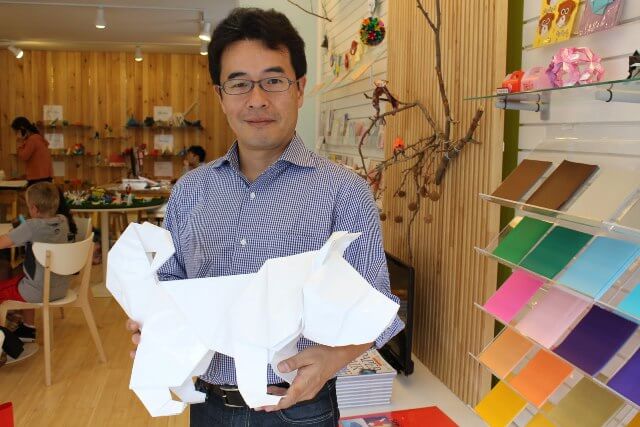
“Sometimes changing the angle of an animal’s head just slightly suddenly makes it feel alive,” he says. A horse, for example, does not need every anatomical detail reproduced to be recognisable. The designer must identify the features that matter most: the neck, the legs, the proportions and the suggestion of movement.
That distinction between technical complexity and expressive clarity is central to Yaguchi’s approach. A model does not become more successful simply because it contains more folds. The design must serve its purpose, whether that means capturing the character of an animal or communicating the identity of a brand.
Commissioned work makes the distinction particularly clear. Before deciding what to fold, Yaguchi considers what the client wants to achieve. The starting point might be a product, an event or the atmosphere of a space. Only then does he determine what origami can contribute. The creative challenge is as much about identifying the right solution as executing it precisely.
When paper becomes architecture
For Yaguchi, one of the most interesting ways to change perceptions of origami is through scale. A small model often invites admiration for the skill required to make it. A work that rises above human height or occupies an architectural space encourages a different response: people begin to consider its form, presence and relationship with its surroundings.
“Small origami is very easily seen as craft or hobby,” he says. “But when a folded form becomes larger than the human body, or begins to occupy an architectural space, people start to look at it differently.”
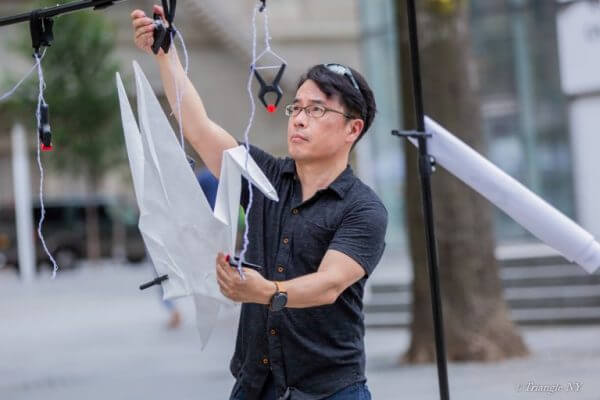
The transformation is not as simple as enlarging a design. Paper behaves differently at a larger scale, and weight, structural support and safety become increasingly important. When an installation consists of hundreds or thousands of pieces, production, transport and placement become part of the design itself.
One recent project involved an installation for a church in Texas, using approximately 2,000 folded birds. Each individual piece was relatively simple, but bringing them together required a coordinated process that extended far beyond folding. The team had to consider how the pieces would be produced consistently, transported and installed, and how the completed work would function visually within the space.
“At that point, the work becomes partly art, partly engineering, and partly project management,” Yaguchi says.
The project illustrates a defining feature of his practice: the individual object is only one part of the finished work. Hundreds or thousands of small forms can acquire a different meaning when arranged together, transforming the environment in which they are displayed. The installation depends on both the precision of each component and the decisions that connect them.
This approach also introduces a practical challenge. A model designed for a single artwork may not be suitable for mass production, while a design intended for a corporate event must meet requirements that an independent artistic project might not. Budgets, deadlines, materials and installation conditions all influence the final result.
For Yaguchi, these constraints are not separate from the creative process. They are part of what professional mastery now means: knowing how to carry an idea from its initial design into the real world without losing what made it compelling.
Why original design needs protection
Yaguchi’s work as a patent attorney has also shaped his views on authorship. Since becoming a professional origami artist, he says he has not used models created by other artists in his professional projects. Instead, he designs each model himself, using established folding techniques as a shared vocabulary while creating original forms for individual commissions.
“In origami, it is not always obvious just by looking at a model whether it is a traditional design or something created by a particular artist,” he explains. That can make recognition of individual creative work particularly important.
For Yaguchi, the issue extends beyond a matter of personal principle. If origami is to develop as a professional discipline, the work involved in designing a model must be recognised as having value. The finished object may be small, but it represents decisions about structure, form and expression that cannot always be understood by looking at the result alone.
His position reflects a broader challenge facing creative fields: how to preserve the accessibility of a cultural practice while ensuring that the people who develop it can earn a living. Origami is widely shared in Japan, including through voluntary teaching and cultural events. Yaguchi sees nothing wrong with that tradition, but believes it should not be the only model available to practitioners.
“If we really want a culture to survive over the long term, I think there also need to be people who can make a living from it,” he says.
The distinction matters because cultural preservation and commercial activity are often treated as opposing priorities. Yaguchi sees them as closely connected. A tradition that supports professional careers can continue to attract skilled practitioners, encourage original work and reach new audiences. For that to happen, creative ownership must be taken seriously.
What origami can learn from fashion
Yaguchi’s thinking about the relationship between art and business is partly inspired by the fashion industry. Major fashion houses operate commercially, but their identities are not built on products alone. Experimental runway collections can establish a designer’s creative direction, shape the way a brand is perceived and influence the value attached to its wider offering.
He sees a similar opportunity for origami. Workshops, corporate events, products and commissioned installations can provide the commercial foundation. More ambitious artistic projects can demonstrate the possibilities of the discipline and establish a recognisable creative identity.
“We have workshops, products, corporate events, and commercial projects, but above that there also needs to be an artistic expression that shows what Taro’s Origami stands for,” he says.
The comparison offers a different way to think about the value of an artwork. Its importance does not have to be measured solely by the price of an individual object or the complexity of its construction. An artistic project can also contribute to the identity of a practice, giving audiences a clearer sense of its ambitions and distinguishing it from more conventional applications.
Yet Yaguchi is careful not to offer an easy definition of fine art. He continues to consider what separates an ordinary origami model from a work that people experience as art. Scale can change the encounter, but size alone is not enough. The challenge is to move beyond the immediate impression of technical skill and create something that invites a more sustained response.
For a discipline so often associated with the demonstration of dexterity, this is a significant shift in emphasis. The question becomes less about how difficult a model is to fold and more about what the finished work allows people to see, feel or experience.
Yaguchi does not consider fine art and business incompatible. Instead, he sees the artistic side as a way to establish the value of the wider practice, while commercial work can support its continued development. The relationship is not automatic, but it is one he is actively trying to build.
Mastery without a final fold
Yaguchi’s definition of mastery has changed over the course of his career. When he was younger, he might have associated it with the ability to fold exceptionally difficult models. Later, he came to see it as the ability to design original work. Now, he is more interested in what origami can make possible.
“I am less interested in technical skill by itself and more interested in what origami can be used to do,” he says.
That includes creating objects, transforming spaces, supporting education and developing commercial projects. It also means considering how a cultural practice that developed in Japan can continue to evolve without losing its connection to that history.
For Yaguchi, preservation does not mean keeping origami unchanged. A tradition can remain alive by adapting to new circumstances, finding new applications and being passed on in forms that make sense to future generations. The challenge is to allow that evolution while recognising the cultural knowledge and individual creativity behind the work.
His ambition is not simply to leave a collection of finished pieces. He wants to help create the conditions in which a young person can realistically choose to become a professional origami artist.
“If one day a young person can say, ‘I want to become a professional origami artist,’ and that is genuinely a realistic career choice, I would consider that one measure of success,” he says.
It is a broader definition of achievement than technical mastery alone. The future of origami, in Yaguchi’s view, depends on whether its creative possibilities can be recognised, supported and sustained. The folded object is only the beginning. What matters is what can be built around it — and whether the discipline itself can continue to grow.