

The old masters advantage: What Christie’s Classic Week reveals about collecting for the long term
As Christie’s Classic Week returns to Paris, Old Master paintings, royal decorative arts and rare manuscripts offer a different perspective on collecting in a market increasingly attentive to quality and provenance. For private collectors, the appeal lies in understanding what makes an object historically significant, difficult to replace and relevant to future generations, rather than assuming that rarity alone guarantees financial appreciation.
Beyond the contemporary art cycle
The art market’s latest figures suggest that established categories deserve a closer look. According to the Art Basel and UBS Global Art Market Report 2026, global art sales rose 4% to an estimated $59.6 billion in 2025, while public auction sales increased 9% to $20.7 billion. Within the wider fine art market, Old Masters recorded a particularly strong recovery: sales reached just under $1.2 billion, up 30% year on year. European Old Masters rose 38% to $535 million, supported by a higher number of transactions above $1 million. These figures do not establish a universal trend or predict future returns, but they indicate renewed activity in a category whose appeal is built around historical depth and a finite body of works.
Christie’s Classic Week in Paris, running across a series of sales from 27 October to 5 November 2026, offers a useful case study. Its programme spans Old Master paintings and sculpture, French decorative arts, and rare books and manuscripts. The range matters because sophisticated collecting is rarely confined to one medium. A painting may anchor a collection, while furniture, works of art and manuscripts reveal the intellectual, political and material culture surrounding it. For collectors building a private collection over decades, the question is how individual acquisitions contribute to a coherent whole.
The value of a rediscovery
One of the most closely watched works in the Old Masters sale is Jean-Honoré Fragonard’s Tête de jeune femme, estimated at €400,000–500,000. The portrait has not appeared on the public market for a century and was last exhibited publicly in 1957, according to Christie’s. Its significance rests partly on the quality and freedom of Fragonard’s execution, but also on the history of its visibility: an important work that has remained outside public view for generations is now returning to the market.
Such appearances are a reminder that art-market attention is shaped by more than an artist’s name. A work’s condition, attribution, exhibition history, documentation and relationship to other known pieces can materially influence how specialists and bidders assess it. Rediscovery can generate interest, but it does not automatically make an object undervalued. The central task for a collector is to establish what is genuinely new about the work’s market appearance and whether the available evidence supports its proposed importance.
A second example is François Boucher’s Immaculée Conception, estimated at €300,000–500,000. Recently rediscovered, the painting has been linked to a drawing by Boucher held at the Louvre and to the artist’s Assumption in the collection of the National Galleries of Scotland. These connections place the painting within a wider artistic context and give specialists a basis for discussing its development and significance. For a buyer, the research behind such an attribution is not an academic footnote. It is part of the evidence on which a responsible acquisition should be assessed.
Provenance is more than a prestigious name
The decorative arts section of Classic Week makes a related point. A sixteenth-century drinking vessel in the form of a rearing horse, created by German goldsmith Jakob Fröhlich, carries an estimate of €80,000–120,000 and formerly belonged to King Ferdinand II of Portugal. Its appeal combines technical achievement, sculptural imagination and a documented association with a royal collection. Elsewhere, a Louis XV commode stamped by Bernard II van Risenburgh, known as BVRB II, is estimated at €150,000–250,000. The maker’s stamp offers a point of reference for understanding its authorship and place within French cabinetmaking.
Provenance can strengthen an object’s historical narrative and help establish its ownership history, but it should be examined rather than treated as a guarantee of value. Collectors need to understand the quality of the documentation, the object’s condition, the certainty of its attribution and any legal or practical considerations associated with ownership and future resale. A famous former owner may attract attention; the full evidence behind the object is what makes that history meaningful.
The same distinction applies to decorative arts. A piece of furniture or a historic object may be rare, but rarity alone is not a complete investment thesis. Craftsmanship, condition, the survival of comparable examples, the depth of the buyer base and the costs of conservation all affect its appeal. The strongest acquisitions tend to be those a collector can explain in concrete terms: why this object matters, why this example is exceptional and what evidence supports its place in the market.
Rare books and manuscripts: intellectual assets
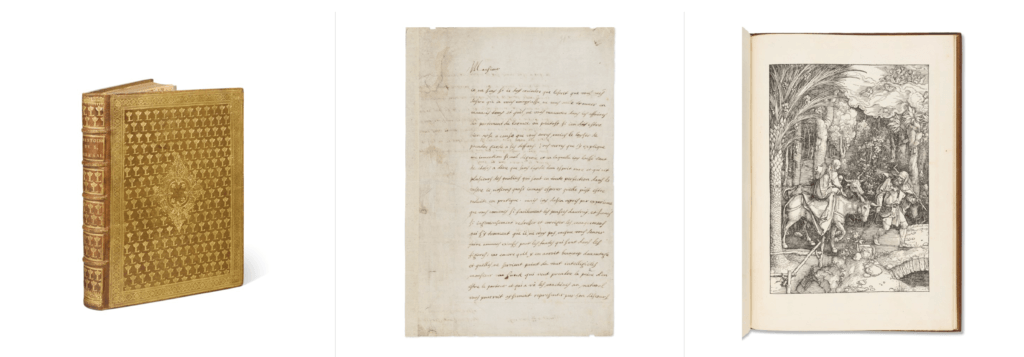
Classic Week extends beyond paintings and objects into the history of ideas. The online Rare Books and Manuscripts sale, running from 27 October to 5 November, includes works associated with Albrecht Dürer, Jean-Paul Sartre, Pierre Boulez and André Breton. Among the highlights are previously unpublished notes in Sartre’s hand relating to Les Mots, estimated at €25,000–35,000, and a manuscript score by Boulez. The sale also includes an important printed edition of Avicenna’s Canon medicinae, produced in Rome in 1593, estimated at €70,000–100,000.
These objects demonstrate how collectors can approach cultural assets through intellectual significance as well as visual appeal. An annotated manuscript, a composer’s score or an early printed book can preserve evidence of how ideas were developed, transmitted and received. Yet specialist knowledge is essential: completeness, edition, condition, authenticity, historical associations and the survival of comparable copies can all distinguish one example from another. Two objects with similar titles may occupy very different positions in the market.
For private collectors, rare books and manuscripts also introduce a different relationship between ownership and legacy. They can form the basis of a focused collection around literature, philosophy, music or scientific history, with a clear intellectual rationale that can be carried forward through generations. Their value, however, depends on the specific object and its market; cultural importance and financial performance are related only imperfectly.
What wealthy collectors should evaluate
The current market offers reasons for interest, not grounds for complacency. The recovery in Old Masters followed two years of decline, and the Art Basel and UBS report describes the broader market as uneven, with results concentrated in particular segments and at the high end. Auction estimates are guides rather than guarantees, and the final cost of an acquisition extends beyond the hammer price to include the buyer’s premium, applicable taxes, shipping, insurance, conservation and storage.
For collectors based in Singapore or managing collections across jurisdictions, the practical questions are therefore as important as the aesthetic ones. How complete is the provenance file? What condition issues might require attention? What are the costs and requirements of transporting, insuring and storing the work? Is the intended holding period compatible with the realities of the market for that category? And if the collection is eventually to pass to heirs, has its documentation been organised so that the next generation can understand what it owns and why?
These are not reasons to avoid collecting. They are reasons to approach it with the same discipline applied to other significant assets, while recognising that art is not a conventional financial instrument. It can offer cultural, intellectual and personal returns that cannot be captured by a resale price, but it is illiquid, expensive to maintain and subject to changes in taste and demand.
Collecting for the long term
Christie’s Classic Week is compelling because it brings together objects whose significance is rooted in different kinds of evidence: the hand of a recognised artist, the skill of a master craftsman, a documented ownership history, a newly established connection to another work, or a place in the transmission of knowledge. Each requires a different form of expertise, and each carries its own risks.
For the serious collector, the objective is not simply to acquire what is rare or currently in demand. It is to distinguish between an object that has a persuasive story and one whose importance can be substantiated; between a price that reflects competitive bidding and a value supported by durable interest; and between a collection assembled for immediate display and one built with a clear sense of continuity.
The most resilient collection may ultimately be the one whose owner understands every acquisition beyond its estimate: its history, its condition, its place in a wider cultural narrative and the reasons it deserves to remain in the collection. In that sense, the lasting advantage in collecting is not a promise of appreciation. It is the quality of judgement behind the purchase.